
Mexico's inflation falls to its lowest level since 2020
The latest dip in inflation brings the rate close to the 3.0% target, and in some details actually reaches it. It may not be enough, however, to convince the central bank to bring its interest rate down another notch. The post Mexico's inflation falls to its lowest level since 2020 appeared first on Mexico News Daily
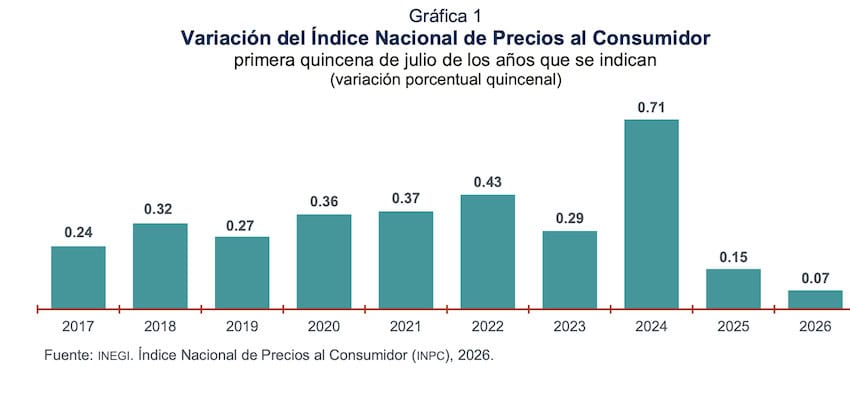
The latest dip in inflation brings the rate close to the 3.0% target, and in some details actually reaches it.
Inflation in Mexico moderated again during the first half of July — the eighth consecutive 15-day period in which the rate declined — settling close to the Bank of Mexico's target.
The national statistics institute INEGI on Thursday reported that the National Consumer Price Index rose 0.07% compared to the second half of June, bringing the annual headline inflation rate to 3.10%. This is the lowest for any quincena , as the half-month period is known, since the second half of December 2020.
The data reflected a slowdown compared to the 3.37% annual rate recorded for the month of June . It also compared favorably on an annual basis. During the first quincena of July 2025, the bi-weekly inflation rate was 0.15% and the annual rate was 3.55%.
INEGI found that the smaller price increase in early July was mainly related to the behavior of the non-core component, which includes volatile prices such as agricultural products, energy and government-regulated tariffs.
This index decreased by 0.23% during the quincena and registered a growth of just 0.21% compared to the same period last year.
Prices for agricultural products fell 0.57% biweekly and accumulated a year-on-year drop of 3.53%. Within this group, fruits and vegetables decreased 1.50% compared to the second half of June.
Tomatoes contributed the most to containing inflation, with a bi-weekly price reduction of 13.18%, while serrano peppers (5.17%), tomatillos (3.24%) and avocados (2.59%) also saw price decreases.
Core inflation, which excludes the most volatile food and fuel prices and is closely monitored by the central bank as a better indicator of the medium-term price trajectory, rose slightly to 3.95% year-on-year, up from 3.94% in June.
Within this component — which increased by 0.16% during the first half of July — goods prices rose by 3.52% annually, while services became 4.36% more expensive.
Processed foods, beverages and tobacco registered an annual inflation of 4.89%; tuition fees increased 5.95%, while the remaining services (restaurants, medical consultations, telephone and tourist activities) increased by 4.83%.
With this latest reading, consumer prices have moderated for eight consecutive fortnights, including four quincenas that hit the central bank's inflation target of between 3 and 4%.
After its June 24-25 monetary policy meeting in which it left the benchmark interest rate unchanged at 6.50%, the central bank indicated that it will await clearer signs that inflation is converging steadily toward the target.
In its meeting minutes, the bank said it expects services inflation to moderate, though at a slower pace than anticipated, with one board member suggesting it might be necessary to keep the rate unchanged for an extended period.
Sinergia Empresarial continuará el seguimiento de esta información sobre mexico's inflation falls to its lowest level since 2020 y ampliará la cobertura conforme se confirmen nuevos elementos relevantes para el ecosistema empresarial.

