
Mexico in Numbers: How Mexico overtook Canada, Japan and China as top exporter to the US
This week's installment of Mexico in Numbers tracks how Mexico overtook Canada, Japan and China over three decades to become the top exporter to the US, reshaping North American trade. The post Mexico in Numbers: How Mexico overtook Canada, Japan and China as top exporter to the US appeared first on Mexico News Daily
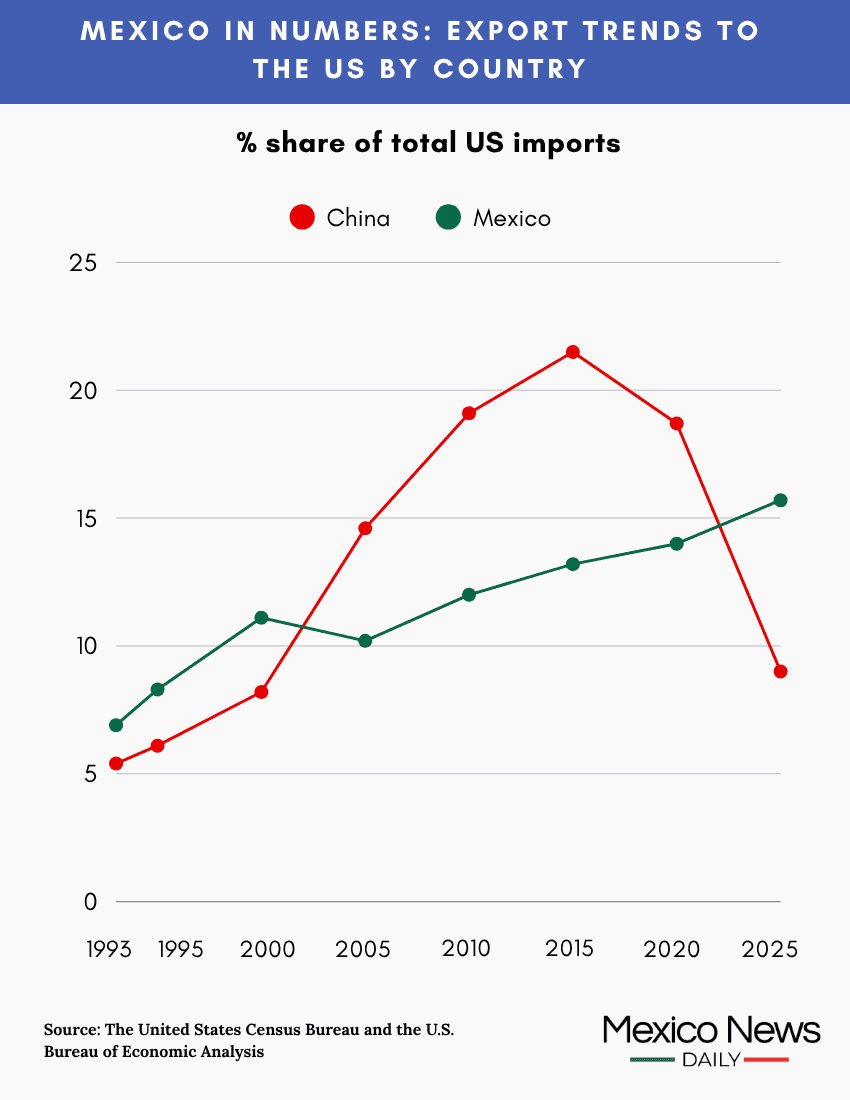
This week's installment of Mexico in Numbers tracks how Mexico overtook Canada, Japan and China over three decades to become the top exporter to the US, reshaping North American trade.
In 2023, Mexico dethroned China as the top exporter to the United States , the world's largest economy.
Since then, Mexico has remained the top exporter to the U.S., occupying the No. 1 position in 2024, 2025 and the first five months of 2026 .
Before Mexico ascended to the enviable position of No. 1 foreign supplier to the U.S., China held the top spot for over a decade. China first became the leading exporter to the U.S. in 2007. Canada snatched back the top spot in 2008 before ceding the position to the East Asian country once again in 2009.
For 14 consecutive years between 2009 and 2022, China was the top exporter to the United States. China was able to get to that position thanks to its vast, low-cost, export-oriented manufacturing sector, the establishment of permanent normal trade relations with the U.S. in 2000 and its membership in the World Trade Organization from 2001 onwards.
In the early 2000s, the country became known as "the world's factory," and in 2013, China became the planet's largest trading nation .
But China's share of the U.S. market for imports began to decline during the first Trump administration , mainly due to the U.S. government's imposition of new tariffs on Chinese goods.
Mexico, among other countries, benefited from the U.S.-China trade war, as the United States "decoupled" from a country it had grown to rely on heavily for all manner of products.
Mexico — which has emerged as a major nearshoring destination in recent years — increased exports to its northern neighbor to the point where, as mentioned above, it became the top exporter to the United States in 2023.
Meanwhile, the shares of the U.S. market for imports held by Canada and China — each of which was once the largest exporter to the United States — declined as the U.S. spent more on goods made in lower-cost economies , such as Mexico and China.
In this "Mexico in Numbers" article, we look at how Mexico, Canada, Japan and China's shares of the U.S. market for imports have changed over the past 30 years or so.
We begin in 1993 — the year before the North American Free Trade Agreement (NAFTA) took effect — then examine the data for 1995 before continuing in five‑year steps right up to 2025.
* All the data in this article comes from the United States Census Bureau and the U.S. Bureau of Economic Analysis.
In 1993 — the year before a North American free trade zone was established with NAFTA — the United States imported goods worth US $580.65 billion .
Canada was the top exporter to the United States that year, shipping goods worth $111.21 billion to its southern neighbor. Thus, Canada had a 19.1% share of the United States total market for imports.
In 1993, neither Mexico nor China was the second-largest exporter to the United States. That distinction went to Japan, which exported goods worth $107.25 billion to the U.S. in 1993, giving the Asian nation an 18.5% share of the U.S. market for imports.
Mexico exported goods worth $39.92 billion to the United States in 1993, giving it a 6.9% share of the U.S. market for imports.
China's exports to the United States were worth $31.54 billion , giving it a 5.4% share of the U.S. market for imports — just one-quarter of the percentage it would achieve around two decades later.

